We perceive time in two distinct dialects: the analog and the digital. The first is a language of arcs and suggestions, a sweeping hand painting the passage of moments in a graceful, continuous stroke. The second is a language of abrupt declarations, of numbers that snap into place with definitive, jarring finality. The history of mechanical watchmaking is written almost entirely in the first tongue, a centuries-old tradition of gears and springs dedicated to the poetry of the circle. To introduce the digital word into this analog realm seems not just innovative, but almost heretical. Yet, it is in this deliberate heresy that A. Lange & Söhne’s Zeitwerk finds its breathtaking, logical brilliance. It is not a rejection of tradition, but its profound and complex evolution—a mechanical mind choosing to speak in a startlingly modern vernacular.
From the moment one beholds the Zeitwerk’s dial, the paradigm shifts. Two large, arched windows for the hours, one smaller square window for the minutes, all presented in crisp, stark Arabic numerals against a pristine backdrop. This is the clearest, most legible declaration of time imaginable, a readout reminiscent of a railway station clock or a precision laboratory instrument. There is no ambiguity, no interpolation required between markers. The time is stated as a fact. But this is where the magic—the deep, mechanical witchcraft—begins. For these are not static numbers printed on a disc. They are solid, individual numerals mounted on three separate jumping numeral discs, lurking behind the serene porcelain-like face. At the top of each minute, the entire mechanism performs a silent, synchronized ballet. With a soft, authoritative snap, the minute disc advances. Every sixty minutes, the right-hour disc jumps, and every ten hours, the left follows suit. This instantaneous change, this mechanical blink, is one of the most mesmerizing spectacles in contemporary watchmaking. It is time made percussive, a tactile and auditory event.
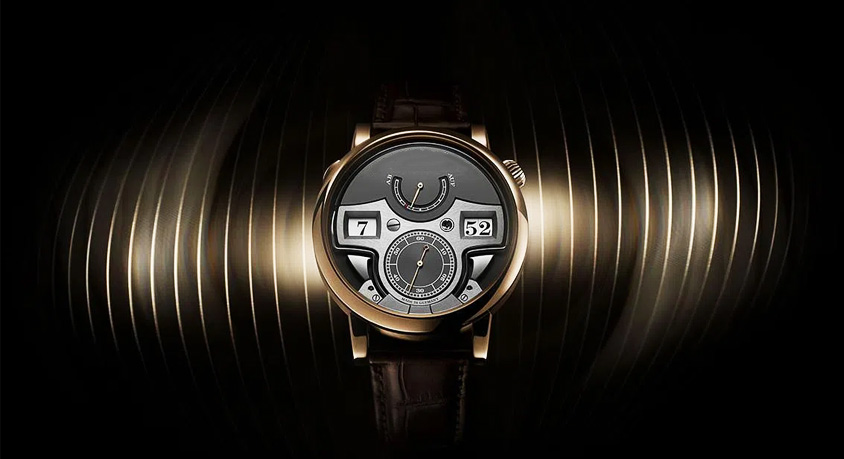
To achieve this digital clarity with purely analog soul requires a feat of engineering that borders on the philosophical. The energy required to instantaneously jump three heavy discs simultaneously, against their own inertia, is immense. A conventional mainspring would deliver uneven force, causing the jump to weaken as power ran down. Lange’s solution is the ingenious remontoir d’égalité, or constant force mechanism. This tiny, fiendishly complex module acts as the watch’s disciplined heart. It stores a small, identical parcel of energy from the mainspring every single second and releases it in one burst every sixty seconds to power the jump. This ensures the jump is as vigorous and precise at the end of the 36-hour power reserve as it is at the beginning. The movement, visible through the sapphire case back, is a Glashütte landscape of poetic finishing: hand-engraved balance cocks, thermally blued screws, and the iconic three-quarter plate made of untreated German silver, all working in concert to perform this single, simple, revolutionary task: to make numbers jump.
Thus, the Zeitwerk becomes more than a timepiece; it is a wearable manifesto. It is for the individual who reveres the painstaking, artisanal past of watchmaking but lives in the unequivocal, data-driven present. It appeals not to nostalgia, but to intellect. Wearing it is an acknowledgment that true progress respects its ancestry not through mimicry, but through intelligent, breathtaking re-interpretation. It connects the wearer to the very instant—that precipice between ‘59’ and ‘00’—with a mechanical certainty that no fluidly sweeping second hand can match. In a world of fleeting digital images, the Zeitwerk offers a profound paradox: the most solid, permanent, and artfully crafted digital readout ever conceived. It does not tell time. It announces it, with the quiet, unstoppable authority of a genius that dared to rewrite its own language.