We spend our lives tracing lines of connection. The fragile thread of a conversation that leads to love, the taut cord of ambition that pulls us forward, the soft, worn string that ties us to memory. These connections are often invisible, felt but not seen, the architecture of a life built on filaments of chance and choice. What if one could pause at the precise point where two such forces meet, to examine the moment of intersection, the deliberate pause where intention becomes bond? Not a beginning, not an end, but the eloquent, complicated middle—the knot.
Tiffany & Co.’s Knot collection, particularly in its singular and dual-loop ear pendants, is an exercise in rendering this philosophical tension into a language of gold and diamond. It is not merely jewelry; it is a grammatical device for the personal narrative. The knot is history’s most ancient and universal symbol of securing, of binding promise, of elegant solution. Yet, in Tiffany’s interpretation, there is no strain, no desperate pull. Instead, we find a composition of pure, rhythmic torque, a frozen moment of dynamic balance that speaks of confidence, not constriction.
Observe the form. The designers have performed a minor miracle of visual semantics. They have taken the idea of a knot—often associated with the rough, the utilitarian, the temporary—and refined it into a glyph of fluid permanence. The ropes, crafted in lustrous 18k white or yellow gold, do not appear to be twisted by force, but rather to have woven themselves together in a spontaneous, organic embrace. This is the heart of the craftsmanship: achieving the look of soft, pliable cordage in a metal that must be both malleable in the artist’s hand and unyielding in its final state. The surfaces alternate between high polish and subtle texture, capturing light like silk catching the sun, emphasizing the fluid, continuous motion of the design.
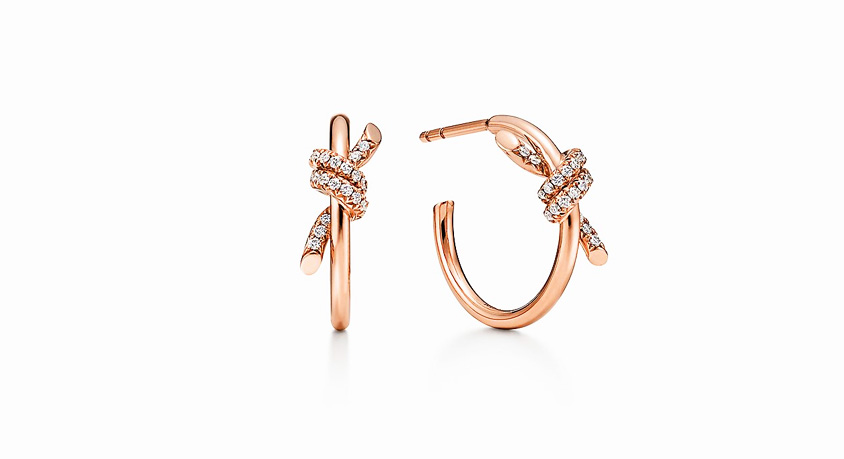
The diamond, in this context, is not a central star but a celestial accent, a point of concentrated light caught within the knot’s embrace. In the single-loop earring, the stone sits like a resolved thought, a period at the end of a decisive sentence. It is a statement of self-containment, a declaration that one’s own resolve is adornment enough. The double-loop variation, however, introduces a compelling dialogue. Here, the rhythm is more complex—a visual echo, a call and response. It suggests partnership, duality, the intertwining of two distinct paths into a single, harmonious journey. The diamonds here are often set as if they are eyes in the pattern, witnessing the union, adding sparks of brilliance at the points of greatest tension and release.
To wear the Knot is to engage with a profound metaphor that rests lightly upon the skin. It moves with the wearer, the loops catching fleeting glimpses of light with every turn of the head, a quiet kinetic sculpture. It suits the woman who understands that her strength lies in her connections—to others, to her principles, to her past and future—but who wears those bonds with effortless grace, not as chains, but as chosen, beautiful complexities. It is for the downtown meeting and the coastal dinner, a piece that speaks of modern sophistication rooted in an age-old human truth.
In a culture that often prizes the straight, unobstructed line, the Tiffany Knot offers a wiser, more poetic alternative. It celebrates the elegant detour, the meaningful tie, the beautiful complication. It acknowledges that the most interesting parts of our stories are not the origins or the destinations, but the pivotal moments where things came together, were secured, and were made intentionally, artistically complex. It transforms the ear from a simple canvas into a locus of narrative, where a loop of gold becomes a sentence, a diamond an exclamation, and the whole, a quiet, enduring testament to the art of connection. It is not an accessory to an outfit, but a punctuation mark for a life richly, intricately lived.