We are a species obsessed with capturing the uncapturable. We press flowers to preserve spring, record songs to trap sound, and in our relentless pursuit to pin down the most elusive element of all—time itself—we invented the chronograph. This is not merely a watch; it is a wrist-worn paradox. It measures fleeting fragments of a second while embodying permanence. It is a tool born of the split-second decisions on the racetrack, yet it has come to symbolize a far more personal victory: the mastery of one's own timeline. In this arena where hundredths of a second decide legends, one instrument has become the unchallenged icon of measured velocity: the Rolex Cosmograph Daytona.
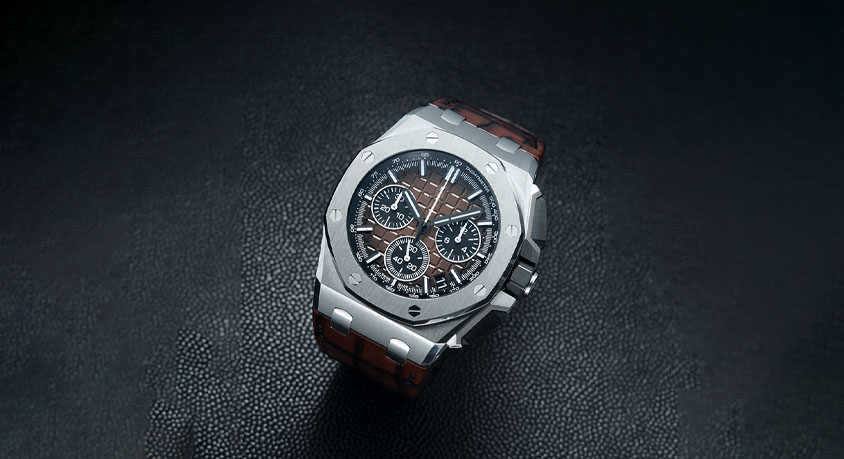
Its very form is a lesson in purposeful aesthetics. The Daytona’s design is a manifesto of clarity under pressure. The tachymeter bezel, engraved or crafted from virtually scratch-proof Cerachrom ceramic, is not a decorative ring but a slide rule for speed, a tool for translating elapsed time into average velocity. The trio of register dials on the face—subsidiary seconds, 30-minute, and 12-hour counters—form a perfectly balanced triad, a visual harmony that belies the complex mechanical symphony operating beneath. The pushers that start, stop, and reset the chronograph are screwed down like the hatch of a submarine, ensuring the watch’s legendary 100-meter water resistance remains inviolable. Every curve of the Oyster case, every facet of the lugs, speaks of a robust, no-nonsense integrity. This is a watch that looks fast standing still, not through flamboyant lines, but through an aura of taut, ready potential.
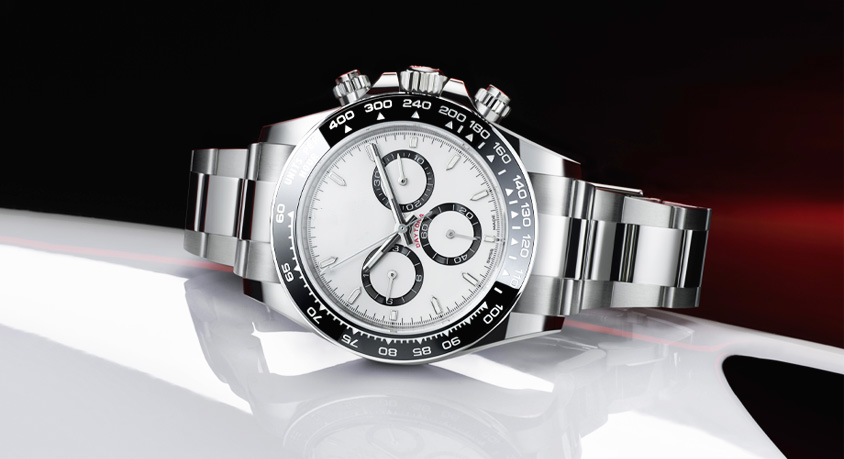
Beneath that iconic face beats a heart of profound technical conviction. The in-house Caliber 4131 is a chronograph movement representing the culmination of decades of refinement. Its architecture is built for reliability, featuring a column wheel and vertical clutch mechanism—the hallmarks of high-end chronographs. The vertical clutch ensures the chronograph seconds hand starts without a stutter, engaging with smooth, immediate authority, while the column wheel guarantees precise, clean operation of the pushers. This complex orchestra of components is shielded by Rolex’s own Paramagnetic blue Parachrom hairspring, making it highly resistant to magnetic fields and shocks, the very disturbances a life of action might present. It is a movement that has earned the title “Superlative Chronometer,” a certification that promises not just accuracy, but exceptional performance. This is the core truth of the Daytona: its soul is engineered for the extremes of competition, yet it delivers that performance with a peerless, daily-wearing elegance.
The name “Daytona” ties it irrevocably to the asphalt and adrenaline of Florida’s legendary speedway, a temple of velocity. Yet, to limit its narrative to motorsport is to miss its greater cultural resonance. The Daytona has transcended its origins to become a universal token of aspiration and arrival. It is worn by the individual who views life itself as a series of pursuits—projects to be completed, goals to be achieved, personal bests to be broken. The chronograph’s function becomes a metaphor: we are all timing our own races, measuring progress against our own benchmarks.
To strap a Daytona to your wrist is therefore to make a quiet but potent declaration. It says you appreciate tools of uncompromising competence. You understand that true luxury is not about ornament, but about underlying excellence—the kind of excellence that performs flawlessly whether timing a lap at Le Mans or the critical moments of a negotiation. It is not a watch that screams; it is a watch that confirms. It confirms a belief in precision, in legacy, and in the profound idea that the most valuable thing we can ever measure is how we choose to spend our own, irreplaceable time.