The Birth of a Cult: When Street Meets Studio
The Balenciaga City Bag wasn’t meant to be a hit. In 2001, when Nicholas Ghesquière designed the prototype—a slouchy, unstructured leather tote with oversized zippers and whip-like tassels—initial reactions were skeptical. Retail buyers passed on it, citing its lack of structure and unconventional detailing. But then something happened: fashion insiders, models, and editors got their hands on the sample. Kate Moss was seen using it before it even reached stores.
Suddenly, the City wasn’t just a bag—it was a statement of subversion. It slid between street and studio, between motorcycle grit and Parisian polish. And over two decades later, it remains a cult object, not just for the aesthetics, but for the attitude.
Material Tension: Distressed Leather as Intentional Imperfection
Unlike many high-end bags that celebrate symmetry and rigidity, the City Bag embraces the beauty of collapse. Constructed primarily from “chevre” (goatskin) or “agneau” (lambskin) leather—hand-dyed and softened through a secretive Balenciaga aging process—each bag begins its life already appearing lived-in. The surface shows micro-creases and color gradations, making no two bags precisely the same.
The leather's feather-like weight belies its resilience. With natural oils integrated into the tanning process, it resists drying and stiffening without ever needing heavy coatings. This raw finish invites patina over time—the peaks polishing, the valleys deepening.
“Each City leather panel is pre-softened in humid chambers for up to 48 hours,” says a former leather technician involved in early production. “It’s not about wear—it’s about memory. The leather remembers how you use it.”
Punk Architecture: Zippers, Tassels, and Edge Hardware
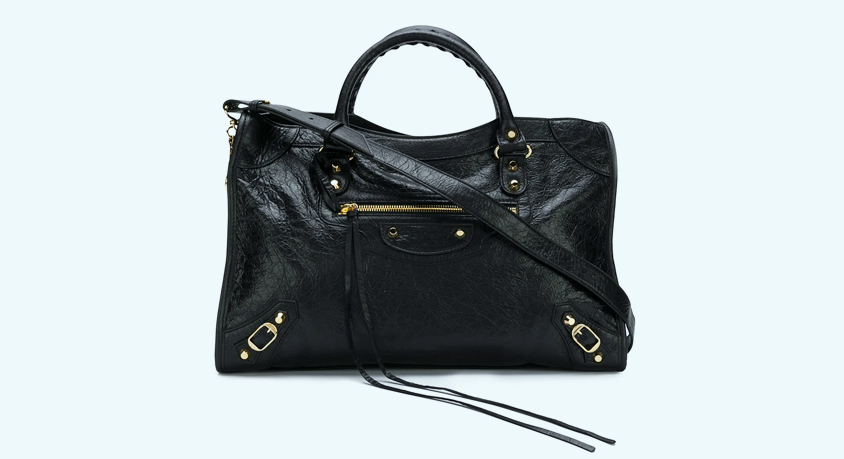
What sets the City Bag apart visually is its all-over hardware ensemble: oversized zippers, distressed brass or blackened nickel studs, buckle tabs, and thinned leather tassels that flutter like fringe in motion. These aren’t decorative—they’re functional components executed with maximum expression. Pockets zip open with a confidence-inducing “clang,” and shoulder straps snap into place with utilitarian rhythm.
The top handles are whipstitched by hand and specially padded with dense foam to retain their structured arch even as the body slouches. On the rear side, the instantly recognizable mini mirror—housed in its own leather envelope—adds semi-ironic flourish and is often appropriated as an identity signature by long-time users.
Paired with wrinkled leather and low-gloss hardware, the overall aesthetic reads like a couture motorcycle jacket reimagined into a carryall.
Inner Logic: Function Disguised as Chaos
The City’s rebellion is calibrated—it may look casual, but it’s designed with intent. The bag’s exterior features a deep front zipper compartment for quick access to cards or keys, while the inside includes a main compartment lined in cotton canvas, a leather-trimmed zip pocket, and an open pouch slot. With dimensions typically around 15 x 9.4 x 5.5 inches (for the Classic Medium), it holds smartphones, wallets, notebooks, and even lightweight outerwear with ease.
A detachable shoulder strap allows for hand, arm-crook, or shoulder wear, keeping the silhouette adaptable yet consistent. Internal seams are left semi-raw to maintain breathability and slouch, and reinforcement panels are hidden within base and handle attachments to prevent sagging over time.
Even its collapsibility is deliberate: remove contents, and it folds nearly flat, allowing for easy storage—or for tucking inside a suitcase as a travel companion.
Era-Defying Styling: From Grunge to Glam Renovation
Few bags move as fluidly across style genres as the City. Pair it with oversized vintage denim and combat boots, and it channels 2003-era indie grunge. Match it with a sharp blazer and flared trousers, and it adds a whisper of anarchy to sophistication. The City excels at both the undone aesthetic and the strategic contrast.
Style Guidelines:
- Choose darker colors like Anthracite, Black, or Ink for maximum versatility and patina payoff.
- In warmer seasons, opt for faded pastels like Rose Des Sables or Vert d’Eau to soften the industrial edge.
- Let the tassels move freely—never tuck them in—as they contribute kinetic energy to the silhouette.
Edition variations include the Giant 21 hardware line (with larger studs), the Mini City (scaled down for crossbody or short carry), and seasonal variations such as metallics, embossed croc finishes, and graffiti-style overlays. Despite the variety, one rule holds: it must feel unedited.
Care Philosophy: Preserve Without Polishing Away
Because the City’s leather finish is deliberately vulnerable, it requires careful, non-invasive care. Twice a year, apply a feather-light layer of leather softening cream with a microfiber cloth—never polish, as this erases the natural scarring and tonal nuances that develop with wear.
Tassels can be smoothed gently with tassel polish balm and reconditioned with natural oils. For storage, use a breathable cotton dust bag and a paper-stuffed core that mimics bag fullness without stretching the leather. Avoid plastic inserts or hard internal forms that may disrupt the slouch.
And as always: wear it. The City is among the rare few luxury bags whose beauty increases with frequent use, not despite it.
Attitude in Bag Form: Why the City Still Matters
The Balenciaga City Bag isn’t timeless in the classic sense—it is timeless in the rebellious one. It resists being tied to an era even as it shaped one. Its leather wrinkles are a diary, its tassels a musical score, its zippers a mechanical ballet.
As luxury trends return to tightness, polish, and symmetry, the City remains gloriously imperfect—insisting that beauty doesn’t need to be flawless. It needs to be free.
Carrying one is never about display. It’s about motion, memory, and mood: a bag that lives with you, not above you.