**
That familiar gnawing feeling, right? You check your savings account, proud of your discipline, but then it hits you: groceries cost more, rent’s up, and that retirement dream feels perpetually further away. Your bank account, the supposed safe haven for your hard-earned cash, feels more like quicksand. I’ve seen this slow erosion of wealth happen countless times, and frankly, it infuriates me. It’s time we called it what it is.
The Illusion of Safety: Why Your Cash Is Shrinking in Plain Sight
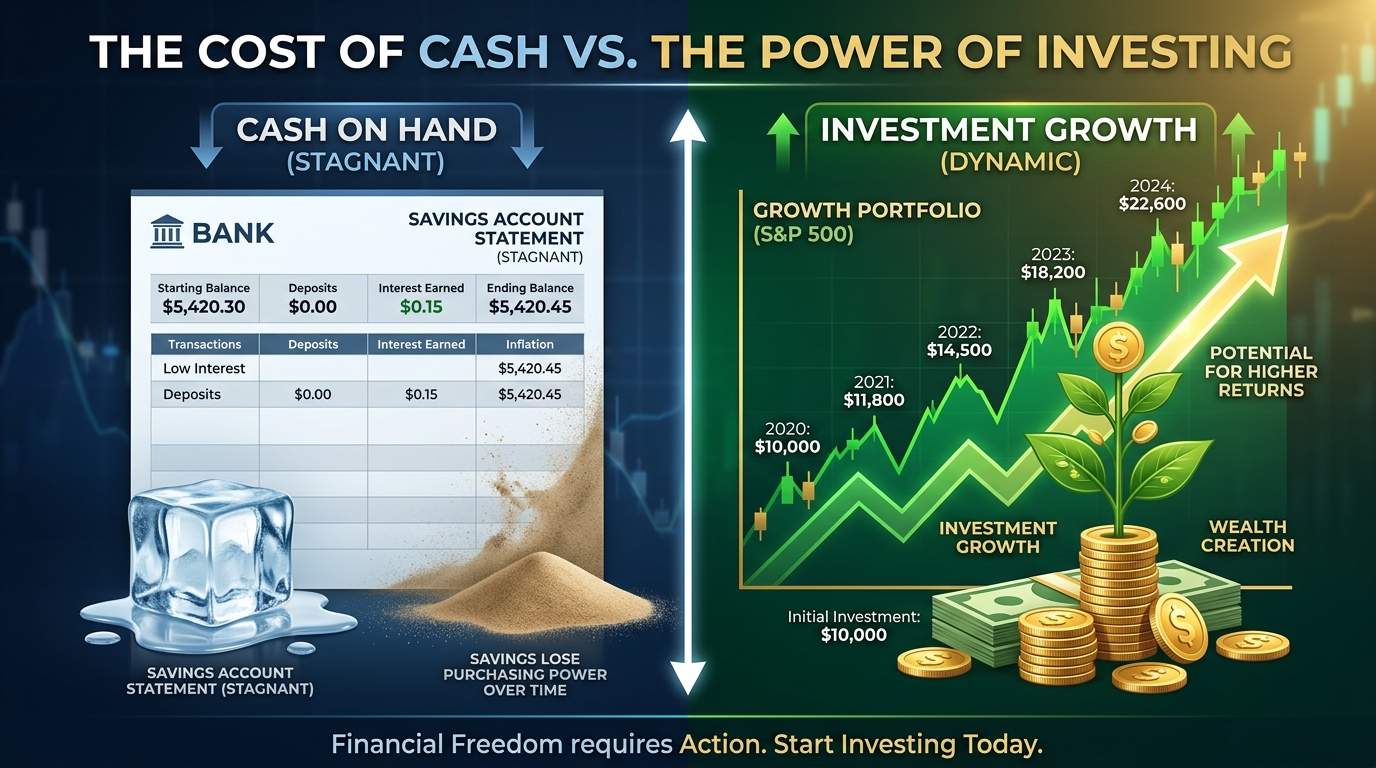
Nobody wants to admit it, but your traditional savings account is a slow-motion wealth destroyer. It’s not a bank vault protecting your future; it’s more like a leaky bucket, constantly losing a bit of its contents. The financial gurus won't spell it out this plainly because, let’s be honest, they often profit from your inertia. This isn't about blaming you; it's about exposing the rigged game.
You see, the dirty little secret is inflation. While your bank might toss you a measly 0.1% or 0.5% interest, inflation has been quietly eating 2%, 3%, or even more of your money’s buying power every single year. It’s like having an ice cube in the desert – it is there, but it’s rapidly disappearing, shrinking your real wealth. That "safe" money? It’s simply less money tomorrow than it is today. This isn't just about losing nominal value; it's about a relentless, silent attack on your future purchasing power.
Beyond the Bank: Real Investing to Grow Your Money
Now, before you throw up your hands and say, "But investing is complicated, it's for the rich!" let me stop you right there. That’s precisely the narrative those slick fund managers love to spin. They want you intimidated, thinking you need a Wall Street MBA to understand it. The truth is far simpler: investing is owning a piece of the future. It’s putting your money to work, so it multiplies, rather than sitting idly by. You don't need a huge sum, nor do you need to be an expert stock picker to begin to grow my money. You just need to understand a few fundamental principles and act on them.
Diversification: Don't Put All Your Eggs in One Basket
This isn’t some abstract financial theory; it’s common sense for long term investments. Imagine you own a fruit stand. Would you only sell apples? What if people suddenly prefer oranges? You diversify. In investing, it means spreading your money across different assets – not just one company, or one industry, or even one country. This inherently reduces your risk. Think of broad market index funds or exchange-traded funds (ETFs); they automatically give you a piece of hundreds, or even thousands, of companies. It's simple, elegant, and far less risky than betting on one "hot" stock someone tipped you off about.
Compound Interest: The Eighth Wonder, Not Just for Geniuses
Albert Einstein reputedly called compound interest the "eighth wonder of the world." Don't let the fancy name fool you; it's just interest earning interest. Your initial investment earns returns, and then those returns start earning returns themselves. It’s a snowball rolling downhill, getting bigger and faster with time. The key is starting early and letting time do the heavy lifting. Don't underestimate its power just because it sounds boring; it’s the engine for beat inflation investment.
Cutting Through the Jargon: Understanding Long-Term Investments
If you've ever tried reading a financial prospectus, you've probably felt like you needed a decoder ring. "Alpha," "Beta," "P/E Ratios"—it's all designed to make you feel stupid, to make you hand over control to those who speak the secret language. But let's strip it bare: a long term investments strategy is simply buying something productive today that you expect to be worth more tomorrow. We're talking about businesses that make real products or services, real estate that provides shelter, or even bonds that lend money to stable governments or corporations.
My personal rule of thumb? If you can't explain what the investment does to a ten-year-old, you probably shouldn't be investing in it. Focus on businesses with strong fundamentals, a clear competitive advantage, and a history of resilience. Ignore the daily noise of market fluctuations. That’s just theatre designed to distract you from the long-term game. True insight comes from understanding the value, not the volatility.
Your Future Self Thanks You: Powering Your Retirement Savings
Here's where human weakness really kicks in: procrastination. "I'll start saving seriously next year," we tell ourselves. But "next year" arrives, and we’re still stuck in the same place. Retirement isn't some distant, hazy fantasy; it's the period of your life when you want the freedom to live on your terms, without the daily grind. Your bank account simply won't get you there. Think of your retirement savings as your future self's paycheque. Every dollar you invest today is a dollar you’re paying to that person, with interest. The longer you wait, the harder your future self has to work, or the less comfortable they'll be.
Start Small, Start Now: The Momentum of Early Action
Forget needing a fortune to begin your retirement savings. Can you spare the cost of a daily coffee? That's your starting point. Many platforms allow you to invest with small, regular contributions, often automatically. The magic isn't in the size of the initial sum; it's in the consistency and the power of compounding over decades. Don't let perfection be the enemy of good. Just start. The biggest regret I hear from people isn't that they invested poorly, but that they didn't start sooner.
Navigating the Noise: Capturing Tomorrow's Technological Dividends
The world is changing faster than ever, and if you’re not looking ahead, you’ll be left behind. Those "technological dividends" aren't about chasing the latest crypto craze or meme stock. They're about identifying fundamental shifts in how we live, work, and consume. Think about the move to cloud computing, artificial intelligence, renewable energy, or biotech breakthroughs. These aren't fads; they're generational transformations that present incredible opportunities for long term investments.
You don't need to predict which startup will be the next unicorn. Instead, consider broad-based exchange-traded funds (ETFs) that focus on innovation or specific sectors with clear growth trajectories. It's about being exposed to the wave, not trying to surf every ripple or get rich quick. Don't mistake speculation for investing; one makes for great dinner party chatter, the other actually builds lasting wealth. Educate yourself, stay sensitive to the future, and align your investments with these inevitable currents.
So, is your bank account making you poorer? Probably. But the real question is, what are you going to do about it today?
**